
American Computer Science League (ACSL)
One of the oldest computer science Challenges with 49 years of history
Approved by the National Association of Secondary School Principals (NASSP)
Authenticated by the Computer Science Teachers Association
Sponsored by Google, Adobe and other advanced technology companies
Based on cumulative team scores, top teams are invited to ACSL ALL Star
4 different levels suitable for students from Grade 3-12/Year 4-13
Past papers are available for preparation
December 2026 - August 2027
Introduction

ACSL organizes computer programming and computer science contests for K-12 schools, organizations and local groups. Last year, about 8,000 students in the United States, Canada, Europe, and Asia participated in the regular season competitions. ACSL is on the approved activities list of the National Association of Secondary School Principals (NASSP). ACSL is also an institutional member of the Computer Science Teachers Association.
Official Website: www.acsl.org
Challenge Rules
Language:
English
Consist
- Round 1 (Top 65% enter Rounds 2-4)
- Rounds 2-4
Date
- Round 1: Dec. 13, 2026 (Sun.)
- Round 2: Feb. 13, 2027 (Sat.)
- Round 3: Mar. 13, 2027 (Sat.)
- Round 4: Apr. 17, 2027 (Sat.)
Form
Online
Programming Language
Any programming language you are good at
Eligibility:
Elementary: Grade 3 - 6 / Year 4-7
Junior & Intermediate & Senior: Grade 7-12 / Year 8-13, 3 students per team (at least 2 students)
Divisions:
- Senior Division is geared to high school students with experience in programming, especially those who are taking a Computer Science AP course.
- Intermediate Division is geared towards senior high school students with computer programming experience, and advanced junior high students.
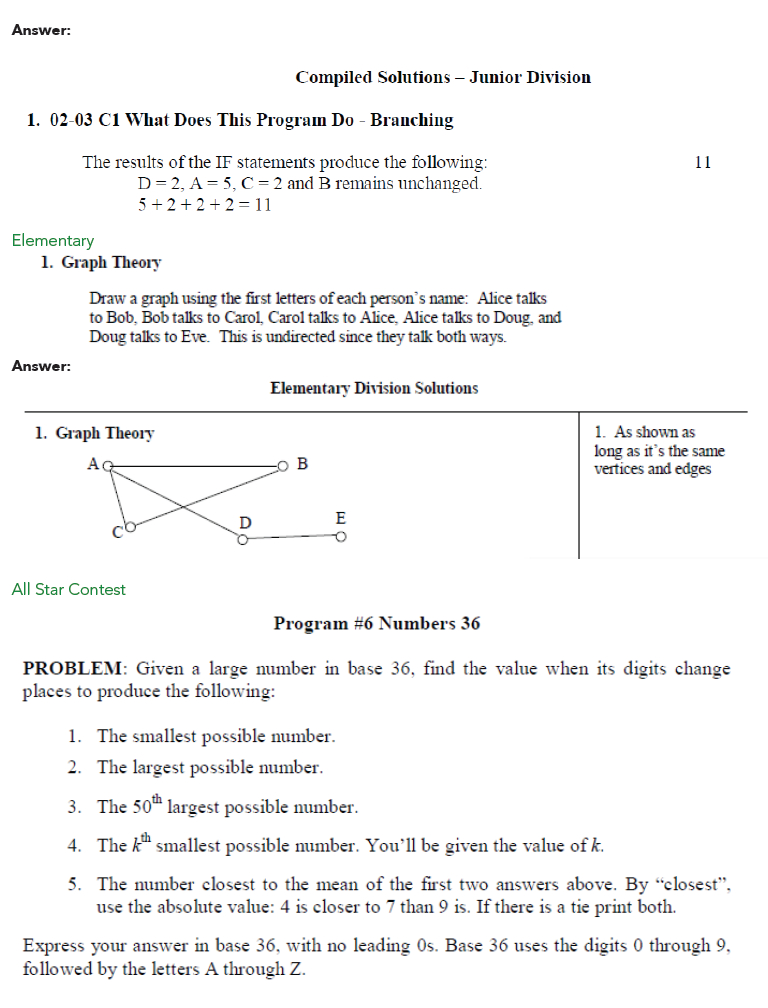
- Junior Division is geared to middle school students with no previous experience in programming. No student beyond grade 9 may compete in the Junior Division.
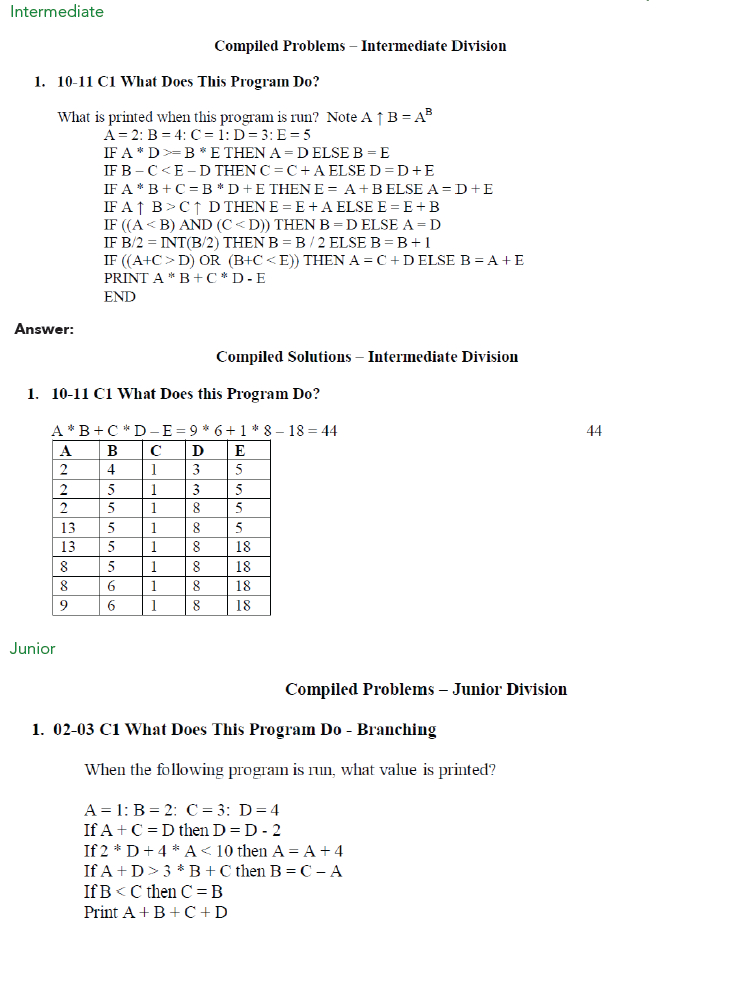
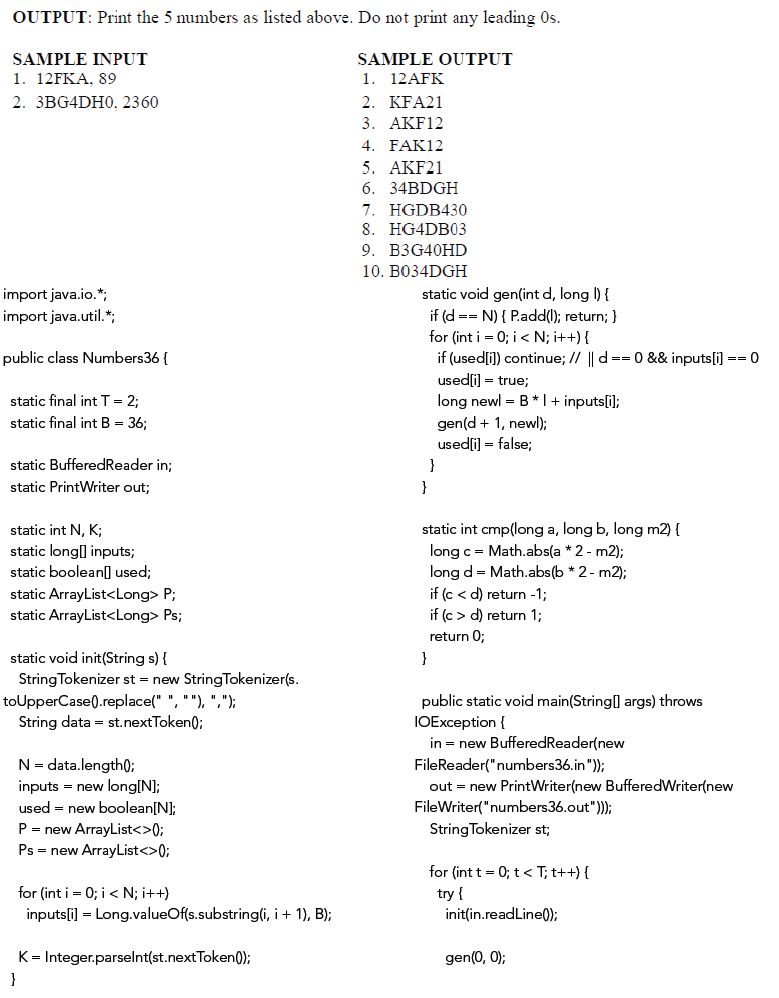
- Elementary Division is open to students from grades 3 - 6. It consists of 5 questions on a computer science topic such as Boolean Algebra and Graph Theory.
Note: Experienced lower grade students can choose higher level contest. For example, primary school students with good programming skills can choose senior, intermediate or junior contest, and junior school students with strong programming skills can choose the senior contest. However, high school students can't choose lower-level contests.
Content
Junior & Intermediate & Senior
- Part 1 (Individual round): 6 multiple choice questions in 30 minutes. 1 point for each question. The full mark is 6 points. Subject to the actual number of questions.
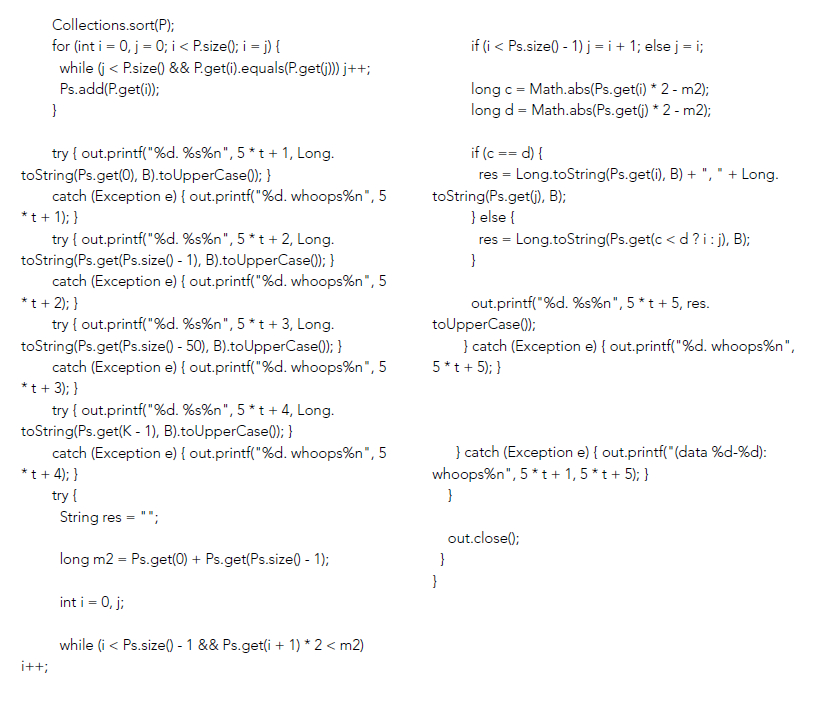
- Part 2 (Team round): 1 programming question in 2 hours, worth 6 points. (All members of the team are required to answer questions and submit answers)
Elementary Division Only Individual written contest: 6 multiple choice questions in 30 minutes. 1 point for each question. The full mark is 6 points. Subject to the actual number of questions.
Grading
- Individual scores: individual multiple choice question scores + individual programming question scores
- Team scores: team multiple choice question average scores + team programming question average scores
Asian Awards
Individual Awards
- Perfect Score: Get a perfect score in Rounds 2 - 4
- Top Scores: top 20% individuals in Rounds 2 - 4
- Honorable Award: Top 55% individuals in Rounds 2 - 4
Team Awards
- Gold: Top 10% teams
- Silver: Top 25% teams
- Bronze: Top 35% teams
- Honorable Awards: Top 55% teams
Reward by different levels. Team members who miss one round at most can receive team awards.
All Star Contest
The winning teams/individuals will be invited to participate in All-Star Contest. The Contest will be held on August 2027. All the teams will compete in their own division.
The topics that are covered in ACSL Rounds 1-4
Each topic is linked to the page of the ACSL wiki
| Division | Elementary | Junior | Intermediate & Senior Division |
| Round 1 | Computer Number System | Computer Number System. Recursive Functions. What Does This Program Do? - Branch |
Computer Number System. Recursive Functions. What Does This Program Do? - Branch |
| Round 2 | Prefix/Infix/Postfix Notation | Prefix/Infix/Postfix Notation. Bit-String Flicking. What Does This Program Do? - Loops |
Prefix/Infix/Postfix Notation. Bit-String Flicking. What Does This Program Do? - LISP. |
| Round 3 | Boolean Algebra | Boolean Algebra. Data Structures. What Does This Program Do? - Arrays |
Boolean Algebra. Data Structures. FSAs and Regular Expressions. |
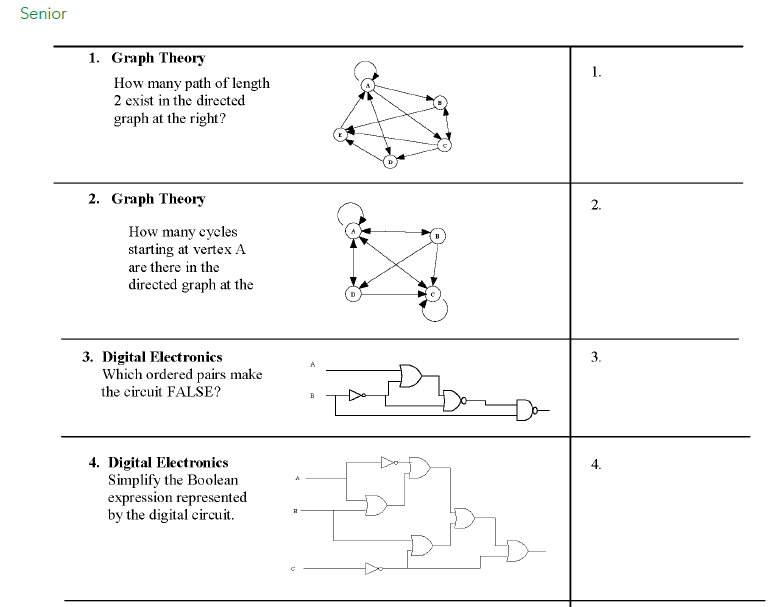
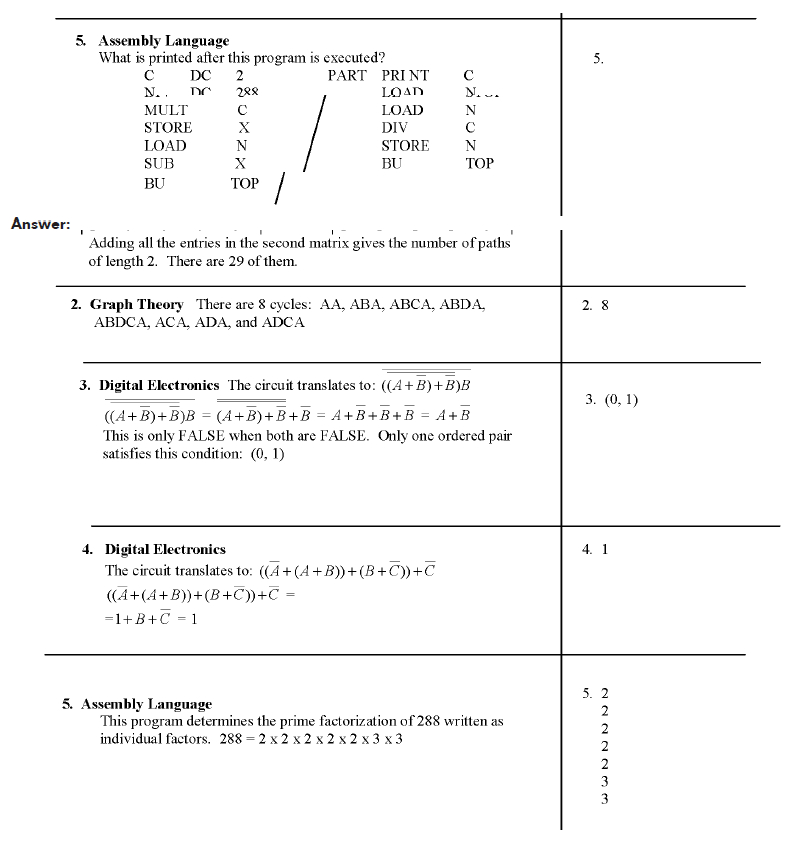
| Round 4 | Graph Theory | Graph Theory. Digital Electronics. What Does This Program Do? - Strings |
Graph Theory. Digital Electronics. Assembly Language. |
*Note: The Short Problems topics are the same in the Intermediate and Senior Divisions. The Senior Division problems are more challenging than those in the Intermediate Division.
All-Star Contest
Date
- Aug. 2027 (TBD)
Content
- Elementary:20 multiple choice questions
- Junior, Intermediate and Senior: 20 multiple choice questions(written contest),2 Programming problems.
*PS:Subject to the actual number of questions. Elementary division only has written contest.
Written Contest
- Elementary:: 60-minute exam consisting of 20 multiple choice questions.
- Junior, Intermediate and Senior:60-minute exam consisting of 20 multiple choice questions. Team members need to answer questions independently
Programming Contest
- Format: 3 students per team (at least 2 students)
- Content: 2 Programming problems scored with 10 points per question. All members of the team are required to answer questions and submit answers. (3 hours)
Awards
- Global Awards(only Individual)
- Gold:Above the score line set by the organizing committee
- Sliver:Above the score line set by the organizing committee
- Bronze:Above the score line set by the organizing committee
- Asian awards
- Top Scores: 1st, 2nd and 3rd Place
- Gold: Top 10%
- Silver: Top 20%
- Bronze: Top 35%
- Honorable Award: Top 50%
Grading
- Individual scores: Individual written scores + Individual programming scores
- Team scores: Average team written scores + Average team programming scores
- If there is a tie, the individual/team with the highest score in multiple choice questions will win; if it is still a tie, the individual/team with the higher programming score will win.
- PS: Points from Regular Season are not counted in All-Star Contest
Agenda(The schedule is subject to the day of the tournament)
| Date | Time (HK time, GMT+8) | Session |
| August 2027 | 08:30-09:00 | Zoom Meeting Debugging |
| 09:00-12:00 | Programming Contest | |
| 12:00-13:00 | Break | |
| 13:00-13:30 | Zoom Meeting Debugging* | |
| 13:30-14:30 | Written Contest (multiple choice)* | |
| 14:40-17:00 | Work Presentation* | |
| 17:00-17:30 | Closing + Awarding Ceremony* |
PS: The schedule is subject to the day of the tournament, Elementary only participate in session marked star(*).
Requirements
Registration Deadline
- 2 weeks before the competition
Computer Device
- Candidates should use their own computer for programming competition.
Sample Problems
St. Catherin College, Cambridge Math Camp
2026 Recap Video
2027 St. Catherin College, Cambridge Math Camp Information
Language:
English
Date:
July, 2027 (TBD)
Eligibility:
Invited Distinction in BMO1 and BMO2 Award Winners
Location:
St. Catherin College, Cambridge, UK (TBD)
Camp Highlights:
· Exceptional Coaching Team from Cambridge
· Curriculum Inspired by Cambridge Undergraduate Mathematic
· Hands-On Mathematics Workshops
· Exclusive Top-Tier Math Camp
· Official Certificate from St Catharine's College, Cambridge
· Immersive Cambridge Experience
How to register?
Please email us at Info.asia@seedasdan.org
Coaches
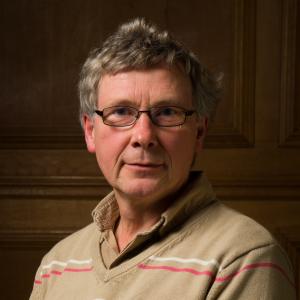
Dr. Sergei Taraskin
Lecturer at St Catharine’s College; Director of Studies in Mathematics for Natural Scientists; Director of Studies in Physical Natural Sciences; Director of Studies in Computer Science; College Tutor and IT Fellow
Dr. Sergei Taraskin
Lecturer at St Catharine’s College; Director of Studies in Mathematics for Natural Scientists; Director of Studies in Physical Natural Sciences; Director of Studies in Computer Science; College Tutor and IT Fellow
Dr. Sergei Taraskin is currently a Lecturer at St Catharine’s College, University of Cambridge. He serves as the Director of Studies in Mathematics for the Natural Sciences, while also overseeing academic guidance and coordination as the Director of Studies in Physics and Computer Science.
Educated in Moscow and having been engaged in teaching and research at the University of Cambridge since 1993, Professor Taraskin’s research interests center on complex systems and non-equilibrium processes, areas closely linked to mathematical modeling and systems analysis.
Over the years, he has supervised numerous interdisciplinary students across various mathematics options. He excels at integrating rigorous mathematical methodologies with real-world problems, helping students develop advanced mathematical thinking centered on modeling, analysis, and academic articulation.
Schedule
Agenda
| Day 1 | Day 2 | Day 3 | Day 4 | Day 5 | |
| Morning | Depart for the United Kingdom | London trip -British museum & Natural History museum | London trip -British museum & Natural History museum | Oxford Trip | Cambridge math courses: Difference Equations: Time-evolving Models, Discrete Systems and Complex Dynamics |
| Lunch | |||||
| Afternoon | Check in the St Catharine's College | London explore -renowned architectures | London explore -renowned architectures | Oxford Trip | Cambridge math courses: Cobweb Diagrams for Real-world Modelling |
| Day 6 | Day 7 | Day 8 | Day 9 | Day 10 | Day 11 | |
| Morning | Cambridge math courses: Difference Equations: Time-evolving Models, Discrete Systems and Complex Dynamics | Cambridge math courses: Difference Equations: Time-evolving Models, Discrete Systems and Complex Dynamics | Cambridge math courses: Difference Equations: Time-evolving Models, Discrete Systems and Complex Dynamics | Cambridge math courses: Difference Equations: Time-evolving Models, Discrete Systems and Complex Dynamics | Research Presentation | Return |
| Lunch | ||||||
| Afternoon | Cambridge math courses: Cobweb Diagrams for Real-world Modelling | Cambridge math courses: Cobweb Diagrams for Real-world Modelling | Cambridge math courses: Cobweb Diagrams for Real-world Modelling | Cambridge math courses: Cobweb Diagrams for Real-world Modelling | Punting & Formal dinner | |
* Schedule may be changed according to the actual situation.
ASDAN EPQ Scholarship
3000RMB/std
Gold
2000RMB/std
Silver
1000RMB/std
Bronze
Noted:The ASDAN Scholarship is only available to Year 10, 11 and 12 students for participating ASDAN Extended Project Qualification(EPQ). EPQ is recommended by the G5 group and many leading universities as a competitive academic experience. Scholarships cannot be exchanged for cash. For further details see:http://www.seedasdan.org/epq/。
Exam Centers
Final Exam Centers
FAQ